The $22 Shipping Mistake Behind Our Mikasa Bella Rosa Vase
2026-09-02 · Elise Laurent
The Tuesday I Stared at a Broken Vase
Back in September 2024, at about 2:15 PM—I remember because the office was quiet after lunch—I opened a Priority Mail box and heard the sound every procurement person dreads. A low, rattling clink from inside. If you've ever opened a box and heard broken ceramic, you know that sinking feeling. The kind that means your $129 Mikasa Bella Rosa vase is now several dozen shards of what used to be the centerpiece for an executive retirement dinner.
Next to the box was a Post-it from our receptionist: 'Delivered 11:40 AM. Box looked a little dented. Didn't think I should refuse it.' (Should mention: the driver left it at the front desk. No signature. No 'leave at door' instruction. Just... dropped.)
I've been procurement manager at a 40-person marketing agency for six years. I've tracked about $180,000 in cumulative gifting and office spend in that time. I build spreadsheets for cost comparisons. I audit invoices for mistakes. I'm the person who argues about total cost of ownership. And somehow, I was standing there holding a bag of broken pieces of what had been a gorgeous Mikasa Bella Rosa vase—the exact model our retiring VP had picked out.
The frustrating part? I knew better. The date, I want to say, was September 12, though I might be mixing that up with the invoice number. All I know for sure is that I made the wrong call on purpose, because I wanted to prove we could cut gifting freight by about 35%. I saved $22. It ended up costing us $259.
What Felt Like a No-Brainer
The plan was simple. Our VP was retiring after 11 years. A colleague asked a question we've all heard: 'What do you get a woman who already owns two sets of china?' Answer: the set she actually wants. She'd mentioned in a meeting that she loved the classic look of Mikasa Wedding Band china. So we ordered a tea set for her and a Mikasa Bella Rosa vase for the center table.
Wait—I should back up. We didn't order the tea set for her only. We ordered a small tea set for her home farewell, plus the vase for a client dinner two days later. The Mikasa Wedding Band china was for the place settings at that same dinner. The whole order came to a ballpark of $1,740. And one delicate vase was riding in a cardboard box.
The shipping quote was where the trouble started. The rep quoted standard delivery at $19. The time-definite delivery option was $41. A $22 difference. In my head, I ran the math: $22 on a $129 vase is 17% of the item price. That felt like a waste. The event was six days away. The trip was about 600 miles. Long story short, I said: 'Standard is fine.'
(I should add that I'd been burned before by vendors who charged 'expedited' fees and then used the same carrier anyway. So part of me was making a point.)
But I forgot the key distinction. The $41 option wasn't just faster. It came with a time-definite guarantee. In procurement terms, I was choosing between a promise and a hope. I chose hope.
The $281 Postscript
Five days later, the package arrived—right on schedule. But the vase didn't make it.
I opened the box carefully. The outer carton looked like it had been in a fight with a forklift and lost. Inside, instead of bubble wrap, there was craft paper. Lots of craft paper. And the vase was wrapped in a single tissue layer, with a little 'Fragile' sticker. I'd assumed 'fine china' would ship like fine china. I didn't verify the packing materials. Classic assumption failure.
The chinaware survived. Mikasa Wedding Band china is durable enough for regular use; that's the point of a dinner pattern. The tea set survived, too. But a slender porcelain vase with sculpted rose details? That's not durable. It's art. It needed the protection we didn't request.
I called the corporate gifting line that afternoon. The representative was polite and didn't argue about the damage claim—thankfully, the photo I'd taken of the packing materials made the issue clear. She agreed to credit the vase itself, since it was clearly a packing failure. Then came the catch: a replacement vase by next day air, with the handling required, would be $281. The vase was covered. The time was on us.
Let me put that in context. The original order was $129 for the vase plus $19 for shipping = $148. If I'd chosen the guaranteed option, it would have been $129 + $41 = $170. Instead, we spent $129 + $19 + $281 = $429. The guaranteed option would have been $170. Difference: $259. I saved $22 and paid $259. You do the math.
Oh, and the replacement arrived at 9:47 AM the next day, signature required, double-boxed, with a 'Fragile' sticker the size of a cereal box. The dinner went without a hitch. Everyone loved the vase. Nobody at the table knew about the $259 mistake. But I did.
What This Taught Me About Corporate Gifting Budgets
The obvious lesson: in urgent situations, buy certainty. The deeper lesson: 'guaranteed delivery' is not a shipping upgrade—it's an insurance policy with a clock.
USPS pricing, effective January 2025, gives a useful baseline: a First-Class Mail letter (1 oz) is $0.73; a First-Class Mail large envelope (1 oz) is $1.50; additional ounce for large envelopes is $0.28. USPS defines large envelopes as no more than 12 inches by 15 inches and 0.75 inch thick. Anything bigger is a package, with package rates. Source: usps.com/stamps.
A vase in a box bigger than those dimensions isn't a letter or a flat. It's a package, and standard package rates don't come with a to-the-minute promise. If the check is 'did it arrive at the right time,' you need the service that says so in writing.
Since that day, our procurement policy has a line called the certainty line. Any item destined for an event, or any fragile item over $50, gets the guaranteed shipping option and insurance. It's not 'expediting.' It's a reliability line item. We use it maybe seven times a year. The extra cost is less than the cost of one cracked vase.
A few practical notes from the post-mortem:
- Ask what packing materials will be used. If the answer is 'craft paper,' upgrade the packaging or the service.
- Photograph the unopened box before touching it. That proof saved us the $129 claim. It doesn't buy back time.
- When a vendor offers a time-definite delivery option, ask what happens if they miss it. Money-back guarantees are worth real money.
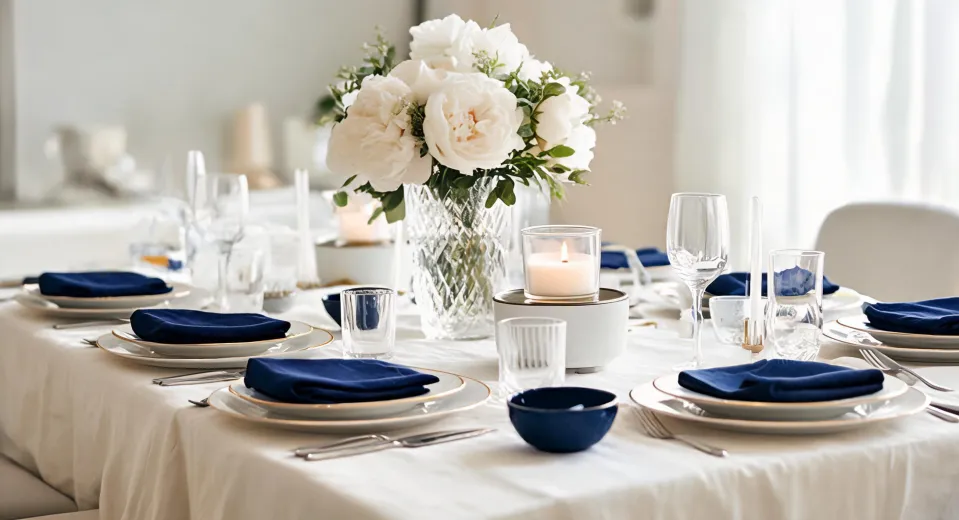
And about the scrapbooking question. People often ask what to buy for scrapbooking—they expect die-cuts, sticker sets, and patterned paper. But after years of corporate events, I'd argue the best scrapbooking supplies are the physical memories of a well-designed moment: a photo of a table set with Mikasa Wedding Band china, a Mikasa Bella Rosa vase as the centerpiece, a hand-addressed note, a branded keychain from the favor table, the embossed box from a tea set. Those are the items that end up in albums for decades. A cracked vase never makes the scrapbook.
Bottom line: if you're ordering Mikasa Wedding Band china for a wedding, a Bella Rosa vase for a milestone dinner, or a simple tea set for a client gift, here's what I'd tell you: don't optimize the shipping line. Optimize the certainty line. The $22 I saved felt like smart procurement for about five days. The $259 bill felt like a tuition payment to the school of 'probably fine.' Trust me on this one.

Elise Laurent
Elise Laurent is a crystal and decorative glass quality analyst covering crystal figurines, vases, ornaments, suncatchers, and gift glassware. She examines ISO 6486-1 where food-contact glass dinnerware applies, then uses polarized strain inspection, dimensional checks, surface-defect grading, and refractive clarity to compare decorative pieces outside that scope. Her work helps sourcing teams choose materials, finishing routes, and protective packaging without confusing visual brilliance with verified durability.